Youth for Sustainable Policy

Loading Youth for Sustainable Policy
YSP Programmes Six programme areas · Six pathways · 83 countries

Take The Pledge.
Then Do The Work.

YSP brings together 700+ young people across 83 countries through six programme areas: Initiatives, Grassroots, the GreenHouse Internship Programme, Competitions, the Global Ambassador Network, and Global Chapters. Every member begins the same way — by making a commitment to the work, and to each other.

6
Programme areas
6
Pathways
700+
Youth members
83
Countries
Annual2026 Results Announced · 5 Nov 20262027 edition coming

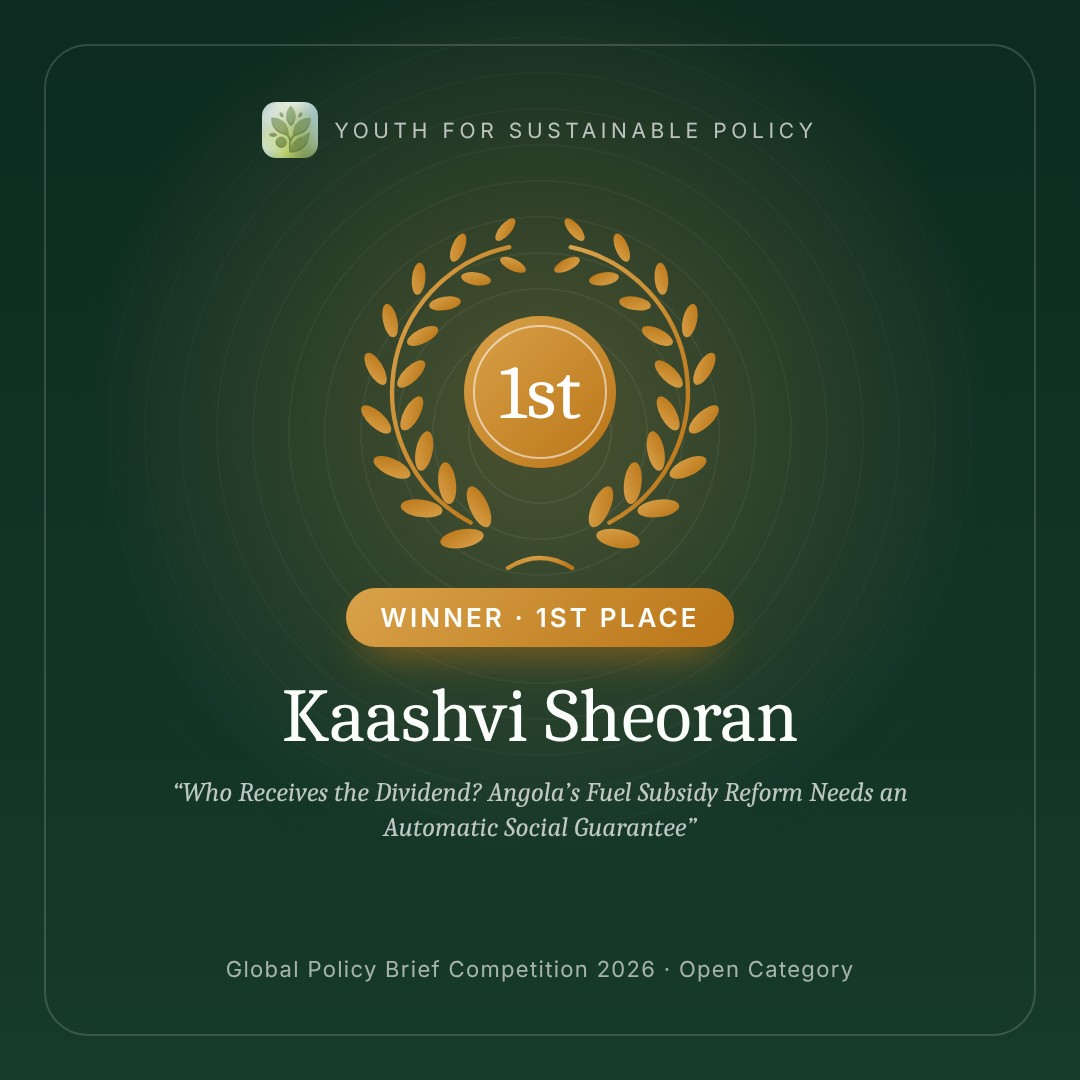
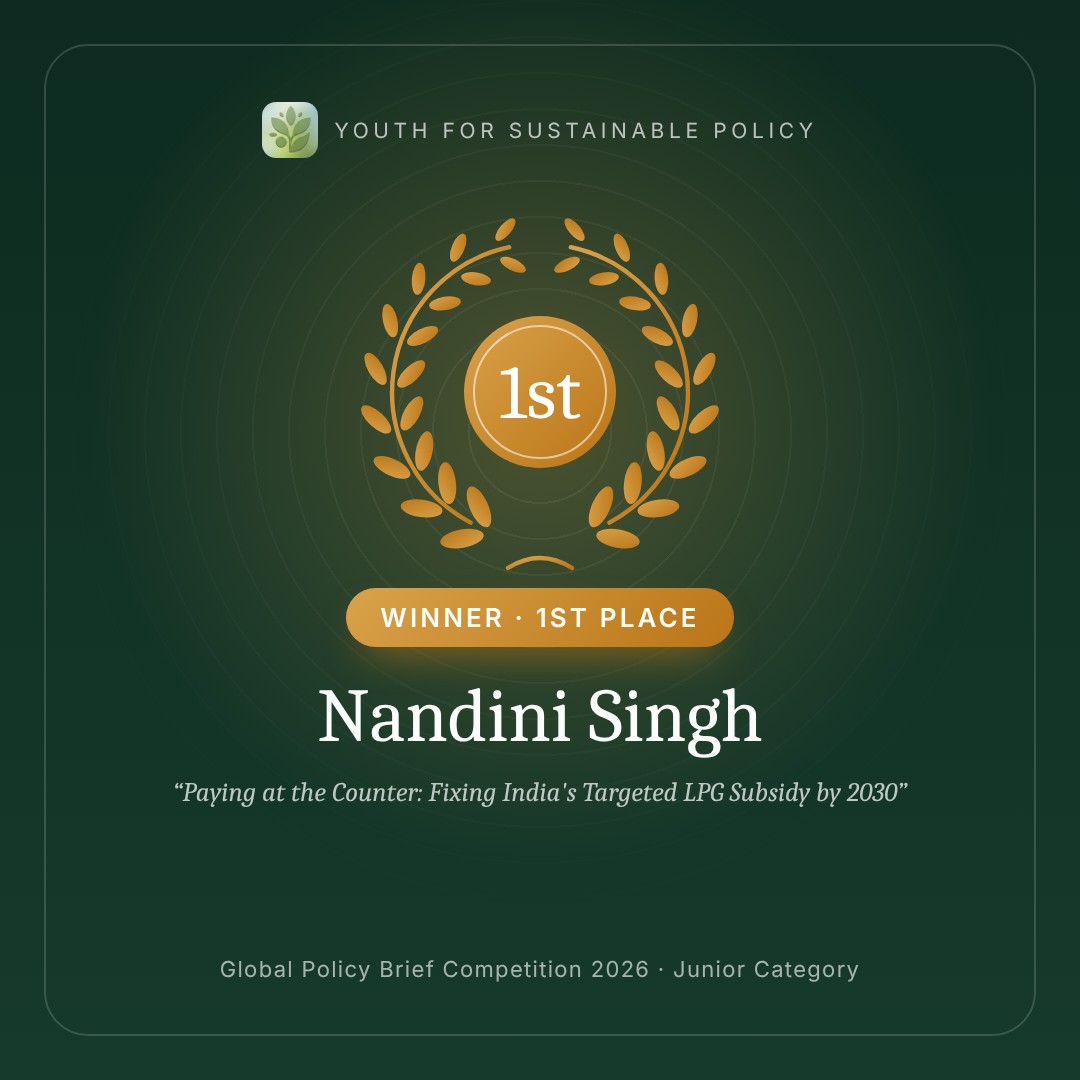
Global Policy Brief Competition 2026.

100+ entries from 40 countries on fossil fuel subsidy reform. Meet the 20 finalists across the Open and Junior categories.

Programme Directory

Six Homes For Every Idea We Build.

Every YSP programme sits in one of six areas — including the ones still taking shape.
In the pipeline

What's Coming Next.

Programme Portfolio 2027 · Proposed

Learn. Apply. Lead.

Nine new programmes in three connected families. Start with something accessible, build practical skills, then move towards research, publication or community leadership.

  1. 01LearnDiscover policy and build foundational knowledgeYSP Learns · Policy Circles · Civic Innovation Hub
  2. 02ApplyUse research, communication and problem-solving skillsData Challenge · Debate Open · Visual Challenge
  3. 03LeadDevelop specialised expertise and leadership experienceFellowships · Chapter Leadership Accelerator
  4. 04ContributeSustained work for YSP and local communitiesYSP Research · Publications · Global Chapters

You can join at any stage. Completing an earlier programme is not a prerequisite.

Learn · Initiatives

Education, Dialogue And Awareness.

Accessible ways in: learn the basics, talk policy with peers and turn community problems into practical proposals.

In development

YSP Learns

Open learning · Policy Foundations

A free, beginner-friendly course introducing public policy through short lessons, practical activities and knowledge checks.

Who
Ages 16–28, no experience needed
Format
Three self-paced weeks
Time
About 45–75 minutes a week
Full Details
Week By Week
  1. Week 1
    What Is Public Policy? Public problems, institutions, a simple policy cycle and stakeholders. Activity: map one local issue with three stakeholders, one option and one indicator.
  2. Week 2
    From Evidence To Action Claims versus evidence, choosing reliable sources, reading simple charts and policy trade-offs. Activity: compare two reliable sources on the same question and note the data’s limits.
  3. Week 3
    Finding Your Voice Consultation, civic associations, participation ethics and constructive recommendations. Activity: draft a 300-word youth participation proposal with one practical action.
How You’re Assessed
  • A five-question quiz each week; pass with 4 out of 5, and retries are allowed
  • Short written work: a 200-word evidence appraisal and a final reflection
  • Applied work is marked out of 10: issue clarity, credible evidence, stakeholder awareness, feasibility and reflection on limitations (2 points each)
To Complete
  • Pass all three quizzes
  • Submit the three activities and the final reflection
  • A certificate is not guaranteed
  • Registrations are not open yet.
Explore YSP Learns ↗
Pilot planned

YSP Policy Circles

Youth dialogue

Moderated, evidence-informed conversations where young people discuss public issues, hear different perspectives and explore possible policy responses.
Who
Ages 16–28
Format
Two 60-minute online circles, 12–18 people each
Time
60–75 minutes a session
Full Details
The First Two Circles
  • Who Gets Heard? Youth Participation In Policymaking. Being informed versus consulted versus influential, the barriers young people face, competing perspectives and one practical improvement institutions could make.
  • Sustainability In Our Community. Local environmental priorities, who is affected and how fairly, two contrasting policy responses and what makes them hard to deliver.
How A Circle Runs
  1. 0–10
    Welcome and ground rules
  2. 10–20
    A short briefing drawn from three sources
  3. 20–40
    Facilitated dialogue in two rounds
  4. 40–50
    Mapping the trade-offs
  5. 50–60
    Closing reflections and feedback
Questions We Explore
  • What does meaningful influence mean?
  • Who is currently excluded?
  • What evidence would change your mind?
  • Which option is feasible, and for whom?
Good To Know
  • Circles are not recorded by default
  • Ideas are shared afterwards only as an anonymous summary of themes; no one is quoted publicly without permission
  • You complete a circle by attending and taking part respectfully, or through an approved written reflection
  • Registrations are not open yet.
Explore Policy Circles ↗
Concept

YSP Civic Innovation Hub

Ideas into action

Small teams identify a community problem, research its policy context, design a practical intervention and prepare a pilot proposal.

Who
Ages 16–28, in teams of 3–4
Format
Six-week project cycle
Time
2–4 hours a week
Full Details
Week By Week
  1. Week 1
    Define the problem
  2. Week 2
    Stakeholder insight Interviews only with approved ethics and consent, or desk research instead
  3. Week 3
    The policy landscape
  4. Week 4
    Prototype an intervention
  5. Week 5
    Feasibility, risk and cost
  6. Week 6
    Present and evaluate
What Your Team Produces
  • A problem statement and evidence map
  • A stakeholder matrix and theory of change
  • A lightweight prototype or proposal
  • Risks, an indicative budget and evaluation indicators
How It’s Judged
  • Problem & evidence 30%
  • Feasibility 25%
  • Inclusion & ethics 20%
  • Policy alignment 15%
  • Clarity 10%
Good To Know
  • Teams prepare proposals only: no real-world interventions, public fundraising or partner commitments without approval
Register interest ↗
Apply · Competitions

Analysis, Argument And Innovation.

Research analysis, live argumentation and public communication, alongside YSP’s existing writing and pitching competitions.

Register Interest

YSP Policy Data Challenge

Evidence & analysis

Analyse open public datasets and turn the evidence into clear policy insights and recommendations.

Who
Ages 16–28, individually or in teams of up to four
Themes
Environment & Climate · Education & Opportunity · Sustainable Communities
Window
21 days to submit; results follow after 2–3 weeks of review
Full Details
What You Submit
  • Your research question
  • The open dataset you used, with its licence
  • An original visualisation or dashboard
  • A 500–800-word analysis with recommendations
  • A methodology and source note, plus limitations
  • A disclosure of any AI use
  • Format: a PDF, plus the spreadsheet/CSV or a reproducible script or link where relevant
How It’s Judged
  • Accuracy & research quality 35%
  • Policy analysis 30%
  • Clarity & visual communication 20%
  • Reproducibility & limitations 15%

Ties are decided on accuracy, then policy analysis. Judging is independent, with conflicts of interest checked.

Good To Know
  • Only licensed public or aggregated datasets may be used
  • Prizes and certificates have not been confirmed yet
Register Interest

Register your interest on the competition page. Entry dates and final rules will be announced separately; expressing interest does not reserve a place.

Register Interest ↗
Register Interest

YSP Youth Policy Debate Open

Argumentation

Teams debate policy motions on governance, sustainability and development, weighing trade-offs and defending evidence-based positions.

Who
Ages 16–28, two speakers per team
Format
Two online preliminary rounds and a final, across two weekends
Time
2–3 hours of preparation a week, plus debates
Full Details
Debate Format
  1. 7 days
    Motion released before each debate
  2. 4 min
    Affirmative and negative statements, each
  3. 3 min
    Moderated rebuttals, each
  4. 2 min
    Closing statements, each
  5. 5 min
    Questions from the judges
How It’s Judged
  • Evidence 30%
  • Argument structure 25%
  • Response & rebuttal 25%
  • Delivery & civility 20%

The final is judged by at least three judges. Scores stay private until verified, and the winner is announced only after verification and a conflict-of-interest review.

Tournament Rules
  • No personal attacks
  • Cite your sources
  • Allowances are made for connectivity problems
  • A minimum preparation time is guaranteed
Register Interest

Register your interest on the competition page. Entry dates and final rules will be announced separately; expressing interest does not reserve a place.

Register Interest ↗
Register Interest

YSP Visual Policy Challenge

Creative communication

Create an original, research-backed infographic or carousel that explains a public policy issue clearly and accessibly.

Who
Ages 16–28, individually or in teams of up to three
Window
21-day open challenge
Full Details
What You Submit
  • One accessible infographic, or a carousel of up to 8 slides
  • A caption and alt text
  • A 150–250-word design rationale
  • A citation list
  • An image and source licensing declaration
  • A disclosure of any AI use
How It’s Judged
  • Research accuracy 35%
  • Clarity & accessibility 30%
  • Visual craft 25%
  • Originality & attribution 10%

Entries are reviewed separately by design and fact-checking reviewers.

Good To Know
  • Being selected for publication by YSP is not automatic; it needs separate permission and fact-checking
Register Interest

Register your interest on the competition page. Entry dates and final rules will be announced separately; expressing interest does not reserve a place.

Register Interest ↗
Lead · Pathways

Fellowships And Leadership.

Supervised, longer-form pathways for young people ready to own a research question, a publication or a chapter.
In development

Civic Futures Fellowship

Research fellowship

Fellows investigate a policy challenge through supervised research and develop a policy memo or proposal around a question they own.
Who
Ages 18–28 for the first cohort; 10–12 fellows
Format
10 weeks, with a research mentor (no more than four fellows each)
Time
3–4 hours a week
Full Details
Week By Week
  1. Weeks 1–2
    Research question, scope and ethics screening
  2. Weeks 3–4
    Evidence collection and literature review
  3. Weeks 5–6
    Analysis and initial drafting
  4. Weeks 7–8
    Peer feedback and substantial revision
  5. Weeks 9–10
    Finalisation, presentation and reflection
What You Produce
  • A research question and project scope
  • An evidence register or annotated bibliography
  • A 1,500–3,000-word policy memo or approved equivalent proposal
  • An executive summary with recommendations
  • A short final presentation
  • A reflection on limitations and future work
How It’s Judged
  • Evidence 30%
  • Analytical depth 25%
  • Feasibility 20%
  • Research integrity 15%
  • Communication 10%
Good To Know
  • Research involving people as subjects needs a separately reviewed research protocol
Explore The Fellowship ↗
In development

Chapter Leadership Accelerator

Chapter leadership

Prepares prospective chapter leaders in governance, safeguarding, approvals, planning and reporting.

Who
Applicants approved for the Global Chapters development pathway; Chapter Director candidates aged 18+
Format
Four weeks, 10–15 candidates
Time
About 2–3 hours a week
Full Details
Week By Week
  1. Week 1
    Governance & chapter foundations
  2. Week 2
    People, safeguarding & team development
  3. Week 3
    Programmes, partnerships & community engagement
  4. Week 4
    Planning, reporting & chapter readiness
What You Produce
  • A proposed founding team structure
  • A 90-day chapter activity plan
  • A local stakeholder and community map
  • An introductory programme or event proposal
  • A safeguarding and operational risk assessment
  • A reporting and communication plan
How It’s Judged
  • Governance 25%
  • Feasibility 25%
  • Safeguarding 25%
  • Reporting & communication 15%
  • Inclusion 10%
Good To Know
  • Completing the Accelerator does not mean appointment as Chapter Director or recognition of a chapter
  • Using the YSP name, bank accounts, money, partnerships or events always needs direct approval from YSP HQ
Explore The Accelerator ↗
Concept

YSP Editorial Fellowship

Policy writing

Guides emerging writers through pitching, sourcing, drafting, fact-checking and editorial revision.

Who
Ages 18–28; 6–8 fellows
Format
Eight-week editorial cycle, with editors and fact-checkers
Time
3–4 hours a week
Full Details
Week By Week
  1. Week 1
    Idea development and pitch
  2. Week 2
    Research angle and source assessment
  3. Week 3
    Structure and outline
  4. Week 4
    First manuscript
  5. Week 5
    Substantive editorial feedback
  6. Week 6
    Fact-checking and attribution
  7. Week 7
    Final revision
  8. Week 8
    Editorial assessment and reflection
What You Produce
  • A fully sourced 1,000–1,500-word policy analysis or interview feature
  • A complete reference and source record
  • An editorial revision log
  • A brief reflective statement
How It’s Judged
  • Factual accuracy 30%
  • Analysis 25%
  • Structure & accessibility 20%
  • Response to editing 15%
  • Originality & ethics 10%
Good To Know
  • Completion does not guarantee publication
  • Interviewees must give consent, and interviews go through editorial review
Explore The Fellowship ↗

Register interest in the Policy Data Challenge, Youth Policy Debate Open and Visual Policy Challenge using their competition pages. Competition entries are not yet open. The other six programmes remain in development. Formats, cohort sizes, eligibility and dates are proposed and may change before launch. Submissions will follow our draft Research, Authorship & AI policy.

New programmes

Building Pathways Into Policymaking.

From learning about policy to researching solutions, developing civic innovations, and leading change in local communities, YSP is building pathways for young people to participate in sustainable policymaking.

Proposed

YSP Global Policy Lab

A youth policy research and development programme producing policy briefs, comparative studies, and recommendations.

Flagship outputYSP Policy Lab Working Papers
Pilot size
8–12 researchers
Duration
10–12 weeks
Core activities
Evidence reviews, comparative policy analysis, editorial review
Deliverables
2–3 policy briefs
Proposed

YSP Civic Innovation Hub

A practical innovation programme where youth teams design, prototype, and test solutions to local sustainability and civic challenges.

Flagship outputCivic Innovation Demo Day
Pilot size
3–5 teams
Duration
8 weeks
Core activities
Problem discovery, design workshops, prototype testing
Deliverables
Prototype and impact report
Proposed

YSP Civic Futures Fellowship

A selective, mentored leadership fellowship combining policy research, public engagement, and a capstone project.

Flagship outputCivic Futures Fellowship Showcase
Pilot size
10–15 fellows
Duration
12 weeks
Core activities
Seminars, mentoring, leadership projects
Deliverables
Individual capstone and showcase
Proposed

YSP Career & Pathways Center

A career exploration and professional development platform connecting young people with policy, sustainability, research, and public-sector career pathways.

Flagship outputPolicy Careers & Pathways Guide
Pilot size
30–50 learners
Duration
6-week pilot
Core activities
Career talks, CV clinics, practitioner interviews
Deliverables
Career guide and learning resources
Proposed

YSP Learns

A free, modular learning platform introducing public policy, sustainability, governance, and practical research skills.

Flagship outputPolicy Foundations learning track
Pilot size
Open access
Duration
Self-paced
Core activities
Lessons, quizzes, case studies, guided exercises
Deliverables
4–6 introductory modules
Proposed

YSP Learning Hubs

Small, locally organised learning communities that bring YSP's educational materials and policy discussions into schools, campuses, cities, and online communities.

Flagship outputCommunity Policy Circles
Pilot size
2–3 pilot hubs
Duration
3 months
Core activities
Facilitated discussions, local workshops, policy circles
Deliverables
Activity reports and participant feedback

All six programmes are in development. Pilot sizes and formats are proposed and may change before launch.

Six Tracks

Pick The Route That Fits The Work You Want To Do.

Every track is built around an Impact Project — a final piece of work that's grounded, publishable, and yours. Below is a quick view; the homepage has full descriptions and intake dates.

Not sure which track is right for you? Download our full programme overview to explore all six and find the best fit.
↓ Programme Overview
✦ The YSP Pledge · A standing commitment

We Need Your Voice,
And Your Commitment.

By taking this pledge, you are acknowledging your role in shaping the world young people will inherit — and your responsibility to engage with the systems, policies, and decisions that determine its future.

You are also supporting Youth for Sustainable Policy, a youth-led initiative bridging research, storytelling, and policy dialogue across Singapore and Southeast Asia. By signing, you stand alongside us — and become part of something bigger.

The Pledge
01

I willuse my voice to advocate for equitable, evidence-based policy — even when it is uncomfortable.

02

I willtake initiative in learning about the systems that shape our world: social, environmental, and economic.

03

I willnot remain silent when policy decisions affect those with the least power to resist them.

04

I willtranslate complex ideas into language that others can access, understand, and act on.

05

I willstand in solidarity with communities whose futures are shaped by decisions made without them.

06

I willuse my knowledge and privilege to amplify youth voices that are overlooked in policy conversations.

07

I willapproach every issue with curiosity, rigour, and a commitment to getting it right — not just getting it done.

08

I willcollaborate across disciplines, borders, and backgrounds, because no single perspective is enough.

09

I willhold myself and my community to the highest standards of honesty, accuracy, and care.

10

I willremember that sustainable change begins with informed young people willing to act.

✦ Sign the YSP Pledge ↗

If you have any questions, please reach out to youthforsustainablepolicy@gmail.com.
We may use your email to contact you about future YSP opportunities, cohort openings, and events.

✦ This pledge is not legally binding.
How It Works

From Application To Impact In Four Steps.

YSP is a student-driven programme. We guide you through every step — from interest to integration.

1

Express Your Interest

Fill out the Expression of Interest form for your preferred track. Tell us about yourself, your background, and what you hope to learn. No experience necessary.

Step One
2

Join a Cohort

Accepted members are matched to a cohort of 20–30 peers across Singapore and Southeast Asia. Cohorts begin on a rolling schedule.

Step Two
3

Complete the Programme

Work through your track's 16-week curriculum asynchronously, with structured touchpoints, discussions, and skill workshops throughout.

Step Three
4

Present Your Capstone

Deliver your final project to the YSP community and receive your certificate. Top capstones are featured in our network and alumni database.

Step Four
YSP in Schools

Bring The YSP Curriculum To Your Community.

YSP partners with schools, universities, and youth organisations to integrate our tracks directly into their existing programming. Educators run the curriculum locally; we provide the materials, mentorship, and quality framework.

  • ✓Ready-made curriculum — Full 16-week syllabus, reading lists, and Impact Project Playbook for each track.
  • ✓Mentor network — Your students can be paired with practitioners in our regional network at no cost.
  • ✓Co-branded certification — Students receive a YSP certificate alongside any internal recognition you award.
  • ✓Publishing pathway — Standout student capstones can be featured in the YSP research hub.
Confirm Integration ↗
For Educators

A Drop-in Policy Module
For Your Institution.

We send you everything needed to run a YSP cohort within your school year — from the first lecture deck to the final capstone rubric.

↓Programme OverviewPDF
↓Business Track CurriculumPDF
↓Diplomacy Track CurriculumPDF
↓Capstone Rubric PackPDF
Request the full pack
Next Steps

Two Ways To Start, One Mission.

Whether you're a student ready to apply or an educator wanting to integrate YSP into your institution, here's how to get started.

01 / FOR STUDENTS

Express Interest

Ready to join a YSP cohort? Fill out the Expression of Interest form for your preferred track. We'll be in touch with cohort details and next steps.

Expression of Interest Form →
02 / FOR SCHOOLS & INSTITUTIONS

Confirm Integration

Interested in integrating YSP tracks into your school, university, or youth organisation? Confirm your integration commitment and we'll provide all the resources you need.

Confirm Integration →
Talk to Us

Get In Touch.

Have questions about the programme, curriculum, or how to get involved? Reach out to our team — we read everything and respond as quickly as a small, careful team can.

Programme Director Youth for Sustainable Policy
Quick Links

Everything In One Place.