Youth for Sustainable Policy

Loading Youth for Sustainable Policy
Third PlaceJunior CategoryEnergy PolicyNigeria

Nigeria's Petrol Subsidy Reform: Fiscal Gains, Weak Protection, and a Funded Transfer Rule

Ahmed WallyEgypt
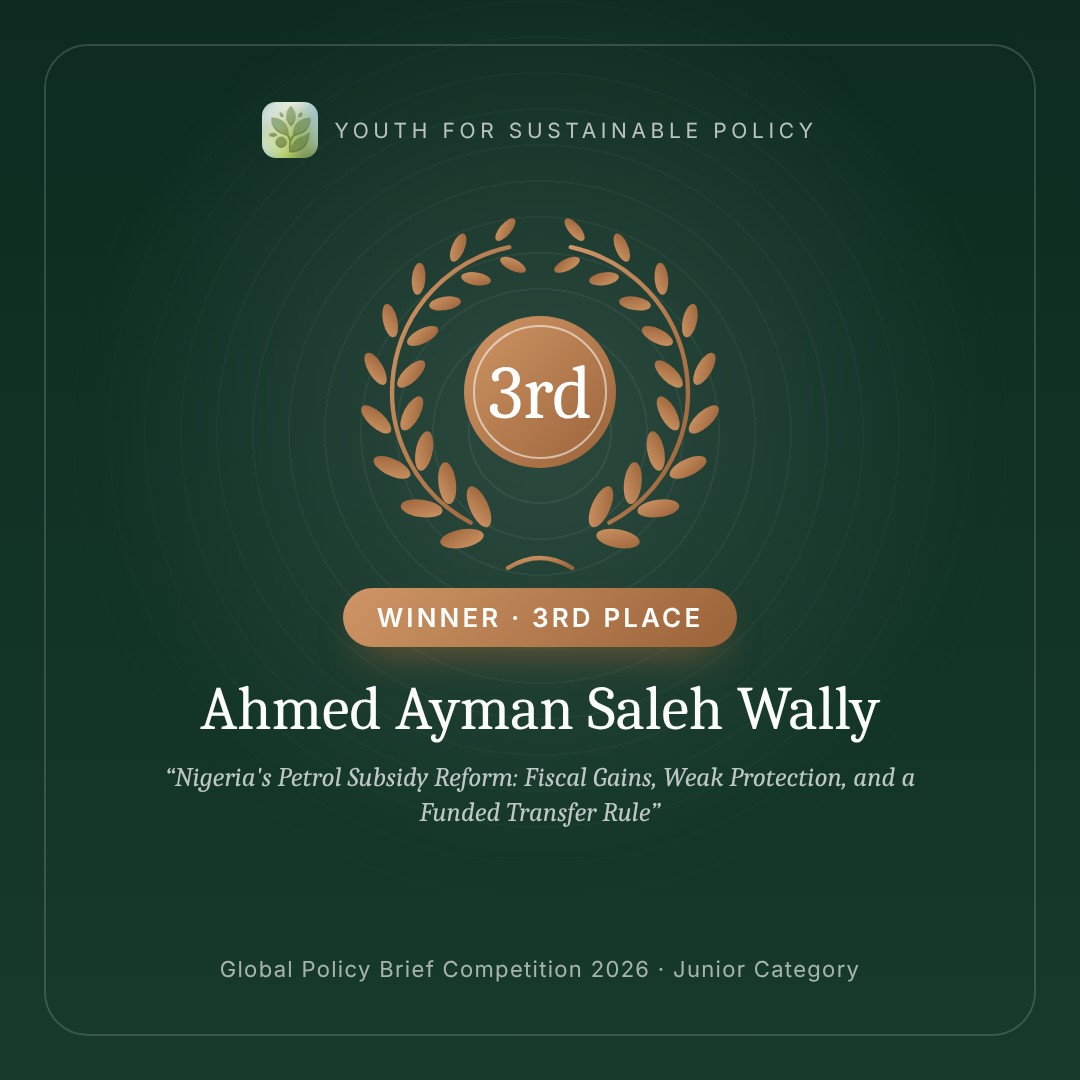
Third Place badge for Ahmed Wally
Executive SummaryNigeria's 2023 petrol subsidy reform was fiscally justified but poorly cushioned for households. The government estimates NGN 15.8 trillion (Nigerian naira) in subsidy savings across the Federation, yet the IMF says savings of up to 2% of GDP did not appear to reach the federal budget in 2025 (Ministry of Finance, 2026; IMF, 2026). A peer-reviewed study suggests the reform reduced cross-border fuel diversion, though not conclusively (Musa & Abubakar, 2025). Meanwhile, enrolled households received at most three NGN 25,000 payments in three years (IMF, 2026). Inflation also had other causes, including naira depreciation and food shortages, so the subsidy cannot take all the blame (IMF, 2025, 2026). Evidence draws on IMF reports, a peer-reviewed study and government data through 2026. This brief recommends one budget rule: a guaranteed cash-transfer line, funded by at least 20% of independently verified subsidy-related federal receipts, with a protected minimum, a public beneficiary ledger, and firm coverage and payment targets for 2028 and 2030.

Policy Context

On 29 May 2023, Nigeria announced the end of petrol subsidies, and pump prices adjusted from June. The IMF dates the completed removal to late 2024 (IMF, 2026). The old system held prices below market levels and encouraged cross-border arbitrage. It was also regressive: richer households that burn more fuel gained more in absolute terms. Nigeria also unified its official exchange-rate windows in 2023, and naira depreciation raised import costs, so the two reforms must be judged together (IMF, 2025, 2026).

Assessment of Effectiveness

Fiscal results. The government's August 2026 scorecard estimates NGN 15.8 trillion in subsidy savings across the Federation for June 2023 to December 2025, of which NGN 5.43 trillion went to the federal level (Ministry of Finance, 2026; Economic Confidential, 2026). These are government estimates, not audited cash. The IMF found that savings from the removal, estimated at up to 2% of GDP, do not appear to have reached the federal budget in 2025, and it flagged a 2.7% of GDP statistical discrepancy in the accounts (IMF, 2026). The fiscal burden fell, but nobody can yet verify how much reached public priorities.

Economic efficiency. Musa and Abubakar (2025) found fuel movements fell 37.8% in border states after the reform, against 27.2% elsewhere. This is consistent with less cross-border smuggling, but the authors say lower demand also contributed and the result is not proof. It is plausible evidence of an efficiency gain, not a measured one.

Household protection and inflation. Enrolled households received at most three payments of NGN 25,000 (about US$18) since 2023 (IMF, 2026). About 10.43 million households had received transfers by August 2026 (allAfrica, 2026b), against a target of 15 million (Naija News, 2025). That is weak protection against a sustained cost-of-living shock. Inflation had several causes: the IMF links the 2024 surge to naira depreciation, food shortages, subsidy removal and high borrowing costs (IMF, 2025). After the statistics office rebased its price index, headline inflation was 15.39% in August 2026 (allAfrica, 2026a). Lower inflation is welcome, but it does not show what the subsidy reform itself caused.

Recommendation

Starting with the 2027 budget, the Federal Government should adopt one rule: a guaranteed cash-transfer line, funded by the greater of two amounts. The first is 20% of independently verified federal receipts attributable to subsidy removal. The second is a protected minimum of NGN 750 billion a year, the cost of two NGN 25,000 payments to 15 million households before administration and inflation adjustment (author's calculation). The minimum matters because subsidy savings did not appear in the 2025 budget (IMF, 2026); payments should not depend on disputed accounting. If verified receipts fall short, the general budget covers the gap.

A universal fuel subsidy may look simpler, but it benefits high-volume consumers and can encourage diversion (Musa & Abubakar, 2025). Targeted transfers can exclude eligible families or arrive late; the 30-day standard, the in-person verification route and public reporting are safeguards within this single rule.

Conclusion

Nigeria's reform likely reduced a costly price distortion and some cross-border diversion, but budget tracking is weak and household compensation has been small and irregular. A budget rule with a protected minimum, a public ledger and firm targets would keep market pricing while ensuring that a measurable share of the gains reaches poor households by 2030.

References

  1. allAfrica. (2026a, September 16). Nigeria inflation falls to 15.39% in August - NBS [reporting National Bureau of Statistics data]. https://allafrica.com/stories/202609160090.html
  2. allAfrica. (2026b, September 21). Nigeria: 67.2m Nigerians covered by cash transfers amid transparency questions - World Bank [reporting a World Bank implementation report]. https://allafrica.com/stories/202609210138.html
  3. Economic Confidential. (2026). Subsidy removal saved Nigeria NGN 15.8trn in 30 months. https://economicconfidential.com/subsidy-removal-saved-nigeria/
  4. Federal Ministry of Finance, Nigeria. (2026, August). Nigeria's Economic Reforms - By the Numbers. https://finance.gov.ng/scorecard/
  5. International Monetary Fund. (2025). Nigeria: 2025 Article IV Consultation (IMF Country Report No. 25/157). https://imf.org/-/media/Files/Publications/CR/2025/English/1ngaea2025001-print-pdf.ashx
  6. International Monetary Fund. (2026, June). Nigeria: 2026 Article IV Consultation (IMF Country Report No. 26/125). https://www.imf.org/-/media/files/publications/cr/2026/english/1ngaea2026001.pdf
  7. Musa, A. U., & Abubakar, S. (2025). Fuel subsidy removal in Nigeria and cross-border smuggling. Energy Research Letters, 6(2). https://doi.org/10.46557/001c.120190
  8. Naija News. (2025, May 17). FG clears two million households for cash transfer [reporting the World Bank's Nigeria Development Update, April 2025]. https://www.naijanews.com/2025/05/17/fg-clears-two-million-households-for-cash-transfer/
Ahmed Wally
About the author

I am an Egyptian high school student with a strong interest in mathematics, engineering, technology, and scientific research. I am particularly interested in aviation engineering, artificial intelligence, and exploring how scientific and technological innovations can address real-world challenges.

I actively seek opportunities to develop my academic and research skills through international programs, competitions, and collaborative projects. I am a member of The Junior Academy at the New York Academy of Sciences and a participant in the Rustic Pathways Climate Leaders Fellowship.

In 2026, I was awarded Third Place in the Junior Category of the YSP Global Policy Brief Competition for my policy brief, "Nigeria’s Petrol Subsidy Reform: Fiscal Gains, Weak Protection, and a Funded Transfer Rule."

LinkedIn ↗

Positions

  • Volunteer – Egyptian Red CrescentParticipating in volunteering and community service activities.
  • Member – The Junior Academy, New York Academy of SciencesCollaborating with an international team on an engineering and sustainability-focused project.
  • Fellow – Climate Leaders Fellowship (CLF), Rustic PathwaysParticipating in a youth fellowship focused on climate leadership and environmental action.

Research interests

  • Sustainable Engineering and Environmental Innovation
  • Renewable Energy and Energy Recovery
  • Aviation and Aerospace Engineering
  • Environmental Policy and Sustainable Development
  • Emerging Technologies and Artificial Intelligence

Current projects and research

  • V.E.I.N.S. Project – The Junior Academy, New York Academy of SciencesWorking with an international team on an innovative project exploring engineering solutions related to sustainability and environmental challenges.
  • Community Garden Clean-Up Project – Climate Leaders Fellowship (CLF), Rustic PathwaysParticipating in a community-based environmental initiative focused on cleaning and improving a public garden and promoting environmental responsibility.
  • Ongoing Research – Wastewater as an Urban Energy Source: Micro-Turbines and Heat Recovery in SewersExploring the potential of recovering energy from urban wastewater systems through micro-turbines and heat recovery technologies, with a focus on sustainable urban infrastructure.
All 2026 Results ↗